
Shuttle Bus Rental Options in New York City 2026
A shuttle bus rental in New York can look simple until group size, luggage, traffic, and driver hours change the quote. The comparison covers named providers and service types for corporate travel, airport groups, weddings, schools, sports, and private events. Here are the options, who each fits, and what to confirm before reserving.
1. New York Bus Company
New York Bus Company provides chauffeured group transportation across New York City, Long Island, and Northern New Jersey. We’re the clearest fit for planners who want one provider for several group sizes and trip types.
Our fleet includes Mercedes Sprinter vans, Executive Sprinter vans, mini buses, shuttle buses, motor coaches, sedans, and SUVs. The stated passenger range runs from 6 to 56 people, so a small executive group can use a van while a larger event may need a motor coach.
We serve Manhattan, Brooklyn, Queens, the Bronx, and Staten Island. Service also reaches Nassau and Suffolk counties, plus cities such as Jersey City, Hoboken, Newark, and Fort Lee.
That coverage works well when one itinerary crosses several areas. A wedding might move guests from a Manhattan hotel to Long Island. A company may need pickups in Garden City before a meeting in Midtown.
We also handle airport movements at JFK, LaGuardia, Newark, Republic Airport, and Long Island MacArthur Airport. For a closer look at vehicle types, see our New York charter bus service.
The main caveat is simple: the right vehicle depends on the final headcount, route, luggage, and schedule. A quote should reflect those details instead of relying on a bus label alone.
2. Best Trails & Travel
Best Trails & Travel is aimed at large tours, school trips, corporate events, and sports teams. It fits groups that care about onboard comfort during a longer ride.
The provider lists amenities such as reclining seats, overhead storage, undercarriage luggage bays, climate control, Wi-Fi, and power outlets. It also mentions upgraded interiors and an onboard restroom.
That mix matters for a school group carrying bags or a sports team moving with equipment. Storage can be as important as seat count. A bus that fits every person may still feel cramped when gear fills the cabin.
For a corporate event, power outlets and Wi-Fi may help passengers work during the trip. For a tour, reclining seats and climate control may matter more.
Best Trails & Travel does not publish every detail a New York planner may need, including a clear passenger range or full pricing model. Ask about vehicle assignment, luggage capacity, driver hours, and route fees before signing.
The term shuttle describes repeated movement between points. Wikipedia’s definition of a shuttle bus captures that basic back-and-forth role, which is different from a single long-distance transfer.
3. Atlantic Coast Charters
Atlantic Coast Charters is positioned for company groups, school groups, sports teams, and other group events. It lists mini charter buses and coaches as vehicle types.
Its published pricing note says charter rentals are usually paid by the hour. That gives planners a useful starting point, especially for local routes with several stops or a vehicle waiting during an event.
Hourly billing can suit a wedding shuttle between a hotel, ceremony site, and reception. It may also fit a corporate meeting where the bus moves people in scheduled waves.
Still, the hourly rate is only one part of the budget. Ask if the quote includes positioning time, tolls, parking, driver overtime, and cleaning. A route that looks short on a map can have a long operating window.
It also does not publish a detailed amenities list. That makes a direct conversation important for groups with luggage, sports gear, or long travel days.
Choose this option when an hourly structure matches the trip. Do not assume a mini charter bus has the same storage or comfort setup as a coach.
4. Charter Buses USA
Charter Buses USA focuses on coordinated group transportation across local, interstate, and multi-day trips. It is especially relevant for employee routes, campuses, conventions, airport connections, and hotel-to-venue service.

The provider lists Wi-Fi, USB or electrical outlets, reclining seats, video equipment, microphones, and onboard restrooms on selected vehicles. Those features can help when a group spends several hours together.
Its planning method starts with passenger movement instead of a generic vehicle name. Planners are asked to share passenger counts, luggage or equipment, exact addresses, and the full operating window.
That approach makes sense for airport groups. Fifty passengers may fit in the seats, but suitcases could change the vehicle choice. A wedding may need repeated evening loops rather than one large departure.
Charter Buses USA also notes that vehicle features vary by market and vehicle. Confirm the exact equipment in writing. Wi-Fi, restrooms, storage, and seating layouts should never be assumed from a broad category.
The tradeoff is that the provider works with a wider transportation network, so the final vehicle depends on the submitted route and availability. Ask who will operate the trip and what appears on the written confirmation.
5. Corporate Employee Shuttle Programs
Corporate employee shuttle programs fit companies that need repeat service between offices, transit hubs, remote parking, or large campuses. The route matters more than the vehicle name.

A good plan starts with actual shift times. Record when employees arrive, when they leave, and how many people use each departure. Then identify safe pickup points near stations or parking areas.
A shuttle provider may offer private shuttles, commuter routes, last-mile service, office moves, and campus transportation. Confirm that the selected operator follows DOT and FMCSA requirements.
For a New York company, routes may connect a Jersey City office with a transit hub or link a Long Island business campus with remote parking. We can also build daily service across NYC, Westchester, Long Island, and Northern New Jersey through our employee transportation shuttle service.
Budgeting should include the number of daily runs and the time between them. A bus that waits all day may cost more than a planned morning and evening schedule. On the other hand, splitting service can leave employees without a ride after late shifts.
Ask about route changes, ridership tracking, backup plans, and the process for adding a stop. Employee programs need a written operating plan, not only a vehicle reservation.
6. Airport Group Transfer Providers
Airport group transfer providers move passengers between terminals, hotels, offices, cruise ports, or event sites. They work best when the planner shares flight details and luggage needs early.

New York groups commonly use John F. Kennedy International Airport, LaGuardia Airport, or Newark Liberty International Airport. Long Island groups may also use Long Island MacArthur Airport, while some Westchester trips involve Westchester County Airport.
Airport planning has two separate problems: seats and bags. A small group with many suitcases may need more cargo room than the passenger count suggests.
We ask for terminal details, hotel loading points, flight schedules, and the names of on-site contacts. Our group airport transportation service can cover airport arrivals and departures across the region.
Traffic adds another variable. Midtown hotel pickups, bridge crossings, terminal roads, and event traffic can affect the operating window. The quote should account for the full plan rather than only the time passengers sit on the bus.
For airport transfers, ask who watches flight changes, where the group meets, and how late arrivals are handled. Confirm the plan before travelers land.
7. Wedding Guest Shuttle Providers
Wedding guest shuttle providers handle hotel-to-venue service, ceremony-to-reception trips, and late-night returns. The strongest plan is built around the guest schedule, not only the wedding start time.

A Long Island wedding may need a loop from hotels in Garden City or Mineola to a venue farther east. A Manhattan wedding may need a simple hotel transfer, while a Hamptons event may involve longer routes between Southampton, East Hampton, or Montauk.
A wedding shuttle provider may offer vehicles in several sizes, so compare capacity with the number of guests, route length, and number of trips.
Give the provider a full itinerary. Include guest hotels, ceremony time, reception time, photo stops, and the final return. Also name one person who can make route decisions on the wedding day.
Repeated loops may work better than one large departure. For example, guests arriving at different times may need two or three scheduled waves. A single bus parked at the venue may not help guests staying at separate hotels.
Ask about loading space, wait time, late-night service, and the exact return departure points. Clear signs and written departure times prevent confusion after the reception.
8. School and University Transportation Providers
School and university transportation providers support field trips, campus routes, airport breaks, athletic travel, and student events. Headcounts and supervision plans need to be set before the vehicle arrives.
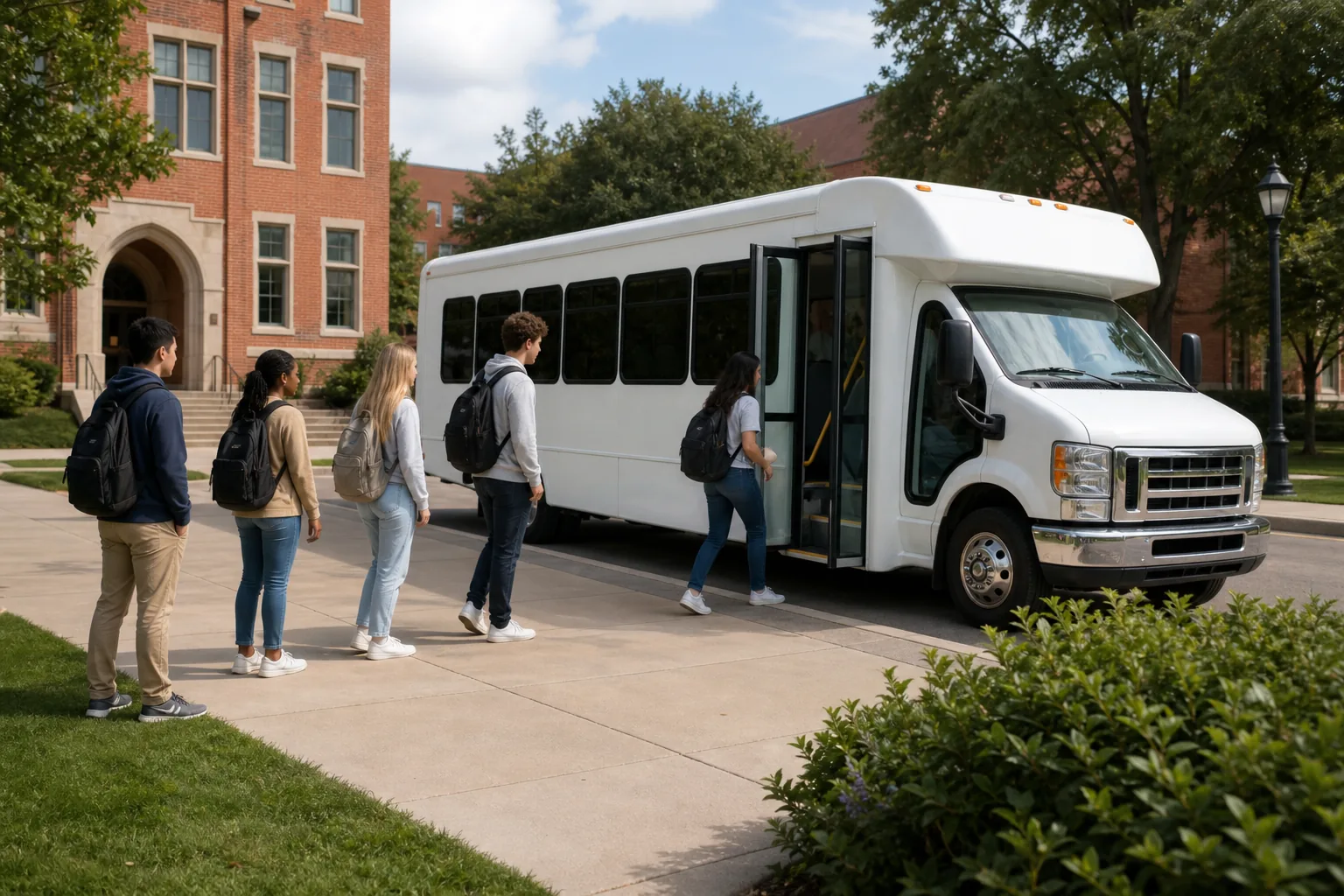
Schools may compare transportation options for field trips, including smaller buses for local travel.
For a school group, the planner should count students, teachers, chaperones, and staff. Then add the addresses for every stop. A museum visit, lunch stop, and return trip can change the bus’s operating window.
Universities may need recurring service between campuses or seasonal airport transfers. Registration, confirmed capacity, departure times, and cancellation terms need clear ownership.
Ask who holds the roster, who meets the driver, and how delays are shared with families or students. The school should also confirm insurance documents and driver qualifications before the trip.
For local field trips, a smaller bus may be easier around city streets. For long travel, luggage and onboard comfort may point toward a larger coach.
9. Sports Team Charter Providers
Sports team charter providers move players, coaches, trainers, and equipment on a schedule tied to game time. The equipment plan can matter as much as the passenger count.

Best Trails & Travel specifically targets sports teams and lists undercarriage luggage bays, reclining seats, climate control, Wi-Fi, and power outlets. Those features may help during longer team travel.
Start with the full roster. Add coaches, medical staff, family members if they are riding, and anyone handling equipment. Then list uniforms, coolers, medical kits, balls, sticks, cases, or other approved gear.
Arrival time needs room for unloading and pre-game tasks. A team arriving at a stadium is not ready the moment the bus reaches the curb. Confirm where the vehicle can load and where it can wait.
New York routes may involve stadium traffic, toll roads, and tight event release windows. A return trip after a late game needs its own departure plan, especially when several teams leave at once.
Ask for the storage layout, interior features, driver schedule, and backup plan. A coach that fits the seats may still be wrong for the gear.
10. Hotel, Convention, and Event Shuttle Providers
Hotel, convention, and event shuttle providers run timed loops between hotels, registration areas, venues, and remote parking. These services need a dispatch plan with clear pickup points.

Convention routes often work in waves. One bus may handle hotel arrivals while another serves the venue. During evening events, the route may reverse and need more frequent departures.
Charter Buses USA lists hotel-to-venue service, convention transportation, airport connections, and remote parking as use cases. Event transportation may also connect airports, hotels, campuses, and convention venues.
A planner should confirm curb access with each property. Large vehicles may need a specific entrance or staging area. A hotel loading zone that works at noon may be blocked during a busy evening event.
Publish departure windows instead of vague instructions. Guests need to know where to stand, how often vehicles arrive, and when the final return leaves.
For a New York conference, the quote should include the full loop schedule, vehicle count, driver hours, parking, tolls, and event release plan. The lowest-priced vehicle may cost more if it cannot keep up with demand.
Shuttle Bus Rental Comparison by Group Size and Use Case
The right shuttle bus rental depends on how people move, not just the largest headcount. A group of 20 with heavy luggage may need a different setup than 30 conference guests with small bags.
| Use case | Vehicle direction | What to confirm | Main risk |
|---|---|---|---|
| Small executive group | Sprinter van or executive van | Seat layout, luggage room, privacy | Too little space for bags |
| Corporate meeting | Minibus or shuttle bus | Pickup waves, outlets, route timing | Missed meeting windows |
| Airport group | Minibus or motor coach | Terminal rules, baggage, flight changes | Seats fit, but luggage does not |
| Wedding guests | Several vans, a minibus, or coach | Hotel loops, venue access, late returns | Guests miss the last departure |
| School trip | Minibus or coach | Roster, chaperones, loading points | Unclear supervision |
| Sports team | Coach with storage | Equipment, arrival time, return plan | Gear crowds the cabin |
| Employee route | Shuttle bus or minibus | Ridership by stop, shift times, changes | Low use on some departures |
Pricing may be hourly, mileage-based, or tied to a full operating day. Atlantic Coast Charters explicitly describes hourly charter rental pricing, while many providers leave the model open until they review the itinerary.
Common cost drivers include vehicle size, trip length, positioning distance, tolls, parking, driver overtime, waiting, and cleaning. Summer weekends, major events, and short-notice bookings can also affect availability and the final quote.
For a local shuttle, ask if the bus can be released between runs. A vehicle waiting through a long event may cost more than two separate transfers, but splitting service can create a gap later.
What to Check Before Booking a Shuttle Bus Rental
Before booking, prepare one written trip brief. It should include the passenger count, exact addresses, pickup windows, stops, luggage, equipment, and final return time.
Ask for the vehicle type and capacity in writing. Also ask what features are confirmed for that specific vehicle. Amenities can vary even within the same category.
Review the quote for tolls, parking, driver hours, waiting, overtime, cleaning, and route changes. If a fee is unclear, ask before paying a deposit.
Confirm that the operator carries the required commercial insurance and that drivers hold the needed qualifications. The commercial driver’s license overview on Wikipedia explains why passenger vehicle operation can require different endorsements from a standard license.
Finally, ask what happens if traffic, weather, a delayed flight, or a venue change affects the schedule. Good planning does not remove every delay, but it gives the group a clear response.
FAQ
How much does a shuttle bus rental cost in New York?
A shuttle bus rental in New York has no single fixed price because vehicle size, hours, mileage, tolls, parking, and date affect the quote. Local services may use hourly pricing, while longer trips may use mileage or day-based pricing. Request an itemized quote with the full operating window, not only passenger travel time.
What size shuttle bus do I need?
The right shuttle bus size depends on passengers, luggage, equipment, route length, and stop pattern. A Sprinter van may fit a small executive group, while a minibus suits a medium local trip. Larger groups may need a motor coach. Count every rider and describe bags before choosing by seats alone.
How far in advance should I book a shuttle bus?
Book a shuttle bus as early as you can, especially for summer weekends, weddings, school trips, sports events, and conventions. Early planning gives the provider more vehicle choices and time to review loading points. Short-notice service may still be possible, but availability and pricing can change quickly.
What information do I need to get a shuttle bus quote?
You need the date, passenger count, exact addresses, pickup times, stops, return time, luggage details, and event contact. Include flight numbers for airport groups and equipment details for teams. A complete brief helps the provider select the right vehicle and identify tolls, parking, waiting, or overtime costs.
Do shuttle bus rentals include a driver?
Most charter-style shuttle bus rentals are arranged with a professional driver, but confirm this in the written quote. Ask who operates the vehicle, what driver hours are included, and how overtime works. You should also confirm insurance, licensing, pickup instructions, and the plan for traffic or route changes.
Conclusion
For groups moving across New York City, Long Island, or Northern New Jersey, start with a provider that can match the vehicle to the full itinerary. New York Bus Company can review your group size, luggage, route, and schedule, then prepare a clear quote. Send those details before reserving so the plan fits the day.